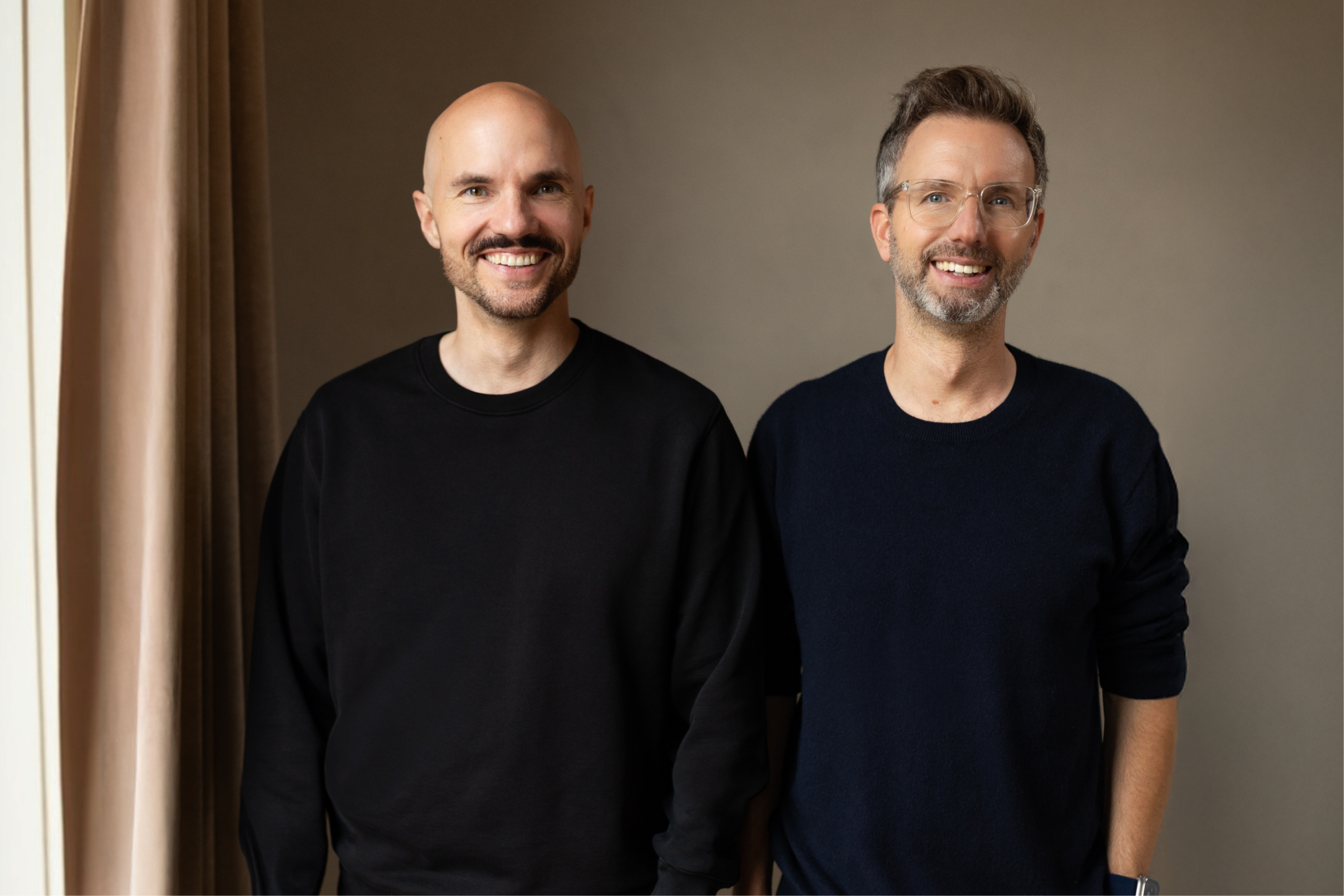

HTGF 2025: Tailwind for Europe’s Wirtschaftswunder 2.0 – Romy Schnelle, Dr. Achim Plum and Sebastian Borek in conversation
News Article
For HTGF, 2025 was a year that demanded many things at once: ensuring stability in the early-stage market, creating internal clarity and giving the starting signal for the next 20 years. In an environment of geopolitical tensions and subdued capital markets, we mobilised follow-up financing volumes in the billions and began to rethink HTGF, transforming it from a classic seed investor into a public-private VC platform that reliably supports founders across all growth phases with capital, networks and expertise.
In our conversation, HTGF managing directors Romy Schnelle, Dr Achim Plum and Sebastian Borek look back on the lessons learned from 2025, talk about AI as a productivity lever, Europe’s opportunities in the global technology race, and why the next economic miracle 2.0 is not just a vision but can become reality through bold investment and consistent scaling.
What were your HTGF highlights in 2025?
Romy Schnelle: Despite a challenging market environment, we delivered strong results in new business. HTGF IV made 40 new investments in 2025 and we are fully on track with a total of around 110 investments in Fund IV. I am particularly proud of the substance of our portfolio. This is also reflected in twelve strong investments by our HTGF Opportunity Growth Fund, from Sdui as the digital backbone for schools to ADCs in cancer therapy, with Tubulis as the European benchmark in life sciences. It shows what we stand for, from AI to nuclear fusion, from robotics to space travel. These are key technologies that will make a difference tomorrow and contribute directly to the high-tech agenda.
Achim Plum: New business was challenging, but our role was clear. To provide stability and enable financing, especially when markets are hesitant. I am particularly proud of the follow-up rounds in our portfolio, which are once again at record levels. We are currently talking about around 1.2 billion euros, almost 90 per cent of which is private capital. For me, this is more than just a number. It shows that we are mobilising private capital on a large scale and thus having a real impact on the ecosystem.
Sebastian Borek: My personal highlight is our enormous potential. As a new member of the management team, I have witnessed first-hand the expertise and competence of HTGF and its team. With our high level of motivation and expertise, which is both broad and deep, we are very well equipped to meet future challenges. With the right attitude, we can do more than just talk about the next economic miracle — we can make it happen.
2025 has not only moved the market, but also HTGF. What has been reorganised and further developed internally?
Achim Plum: 2025 was a turning point for us. After 20 years, we have rethought HTGF. With the management team now complete, we have set out to actively shape the next 20 years. This spirit of optimism is palpable within the organisation. Our value proposition is being redefined, and that’s the right thing to do. We asked ourselves very consciously who we are and what we stand for. This has given rise to our strategic ambition. With new mandates, we are developing HTGF into a venture capital platform that brings together innovation from idea to scaling.
Romy Schnelle: For us, transformation is not just a question of structures, but above all of culture and attitude. We have worked specifically to create clarity in communication, in decision-making processes and in the demands, we place on ourselves. Speed and reliability are not mutually exclusive. Especially in turbulent times, founders and our partners need both.
Sebastian Borek: What particularly convinced me was the substance of the fund and its future viability. It’s about taking the business to the next level and constantly questioning ourselves. For me, this willingness not to rest on our laurels is one of the strongest signals from 2025.
Geopolitical tensions and uncertain markets. What does this mean for start-ups, industry and investors?
Sebastian Borek: We are experiencing the transition to a new industrial era. This creates uncertainty but also opens up enormous opportunities. For us as investors, this means identifying technologies early on that can not only improve existing processes but also transform entire industries. AI is a good example of this because it has an impact across industries. Finding and supporting these technologies at an early stage is part of our responsibility as HTGF.
Achim Plum: Historically, both Germany and Europe have tended to seek social consensus before scaling up. In individual technological fields, such as genetic engineering, this has meant that opportunities have sometimes been missed. Today, however, innovation cycles are too fast for that. What is needed is innovation-friendly regulation and a pragmatic approach that exploits opportunities and manages risks instead of blocking progress out of caution. In times of geopolitical tension, technological and economic sovereignty is becoming increasingly important.
Romy Schnelle: For companies, this means developing expertise and actively seeking partnership opportunities. Those who work with start-ups, research institutions and industry partners from the outset learn faster and can grow more robustly. Data expertise, AI integration and clear processes are key prerequisites for this.
AI is developing rapidly. How do you view the opportunities and challenges?
Sebastian Borek: AI is primarily a question of mindset. It is crucial that we seriously take advantage of its potential. Used correctly, AI can make our work more productive and efficient. Teams that use AI in analysis, product development or operational processes significantly shorten development times and can focus more on value creation. We have seen how a team used AI to produce a market analysis and presentation in one hour instead of two weeks. We must actively help shape AI. That’s clear.
Achim Plum: AI addresses key challenges of our time, from demographic change and productivity to climate change. It acts as a catalyst that accelerates and scales existing approaches. Much of the progress made in the life sciences and medical technology would be inconceivable without AI. In this sense, AI is our superpower.
Romy Schnelle: For founders, it is crucial to use AI responsibly from the outset. Data quality, transparency and clear ethical guidelines create trust. It is precisely this trust that is the prerequisite for sustainable scaling and thus a real competitive advantage.
Apart from AI, which technologies or trends have you been particularly interested in for 2025?
Achim Plum: We see great momentum in the life sciences, from synthetic biology to new forms of therapy. One example is Tubulis. Europe’s largest Series C life science round shows how smart approaches can significantly reduce the risk in drug development. There is also a lot happening in medical technology, for example in neural interfaces and smart prosthetics. AI is often the decisive lever that enables these developments.
Romy Schnelle: Deep tech is experiencing a renaissance. Whether it’s fusion energy, quantum computing and infrastructure, or New Space, the potential for innovation is enormous. Often, it’s not so much the technology that fails, but rather critical financing and the courage to truly scale up. Smooth transitions from research to validation to industrial cooperation are particularly important. That’s exactly where we come in.
Sebastian Borek: In the space tech sector, we are seeing companies that are not only developing products but can build entire industries. This is more than just a market. It is infrastructure for the future. With co-investments, partnerships and a clear platform approach, this can be scaled up across Europe.
HTGF and DTCF are joining forces. What opportunities does this platform open up?
Achim Plum: Our goal is to build an end-to-end venture capital platform that supports technologies from the idea to scaling. Through the close integration of HTGF and DTCF, we are creating a public-private structure that efficiently finances key technologies and gives them the opportunity to stay in Europe and grow here. The decisive factor is supercritical financing, i.e. capital that really supports growth. To achieve this, we rely on flexible models that also enable larger rounds and mobilise private capital.
Sebastian Borek: The DTCF has quickly established itself in the market and demonstrated the importance of strong growth financing. Strong investments such as The Exploration Company or Cylib give companies in the early growth phase time and substance for development and scaling. At the same time, we see how well seed and growth perspectives work together in joint investments by HTGF and DTCF, for example in Proxima Fusion, node.energy or FMC. We are now systematically expanding this integration.
Romy Schnelle: The integration of DTCF and its further development into a platform gives founders the necessary tailwind to build boldly and for the long term. Together with strong private partners, we are creating a financing architecture that supports companies from start-up to scaling, thus enabling new industrial substance in Europe.
Finally, what does the start-up ecosystem need now to turn the tailwind of 2025 into a real economic miracle 2.0?
Romy Schnelle: Above all, it needs consistent cooperation within the ecosystem. When research, start-ups and industry work more closely together, resilient bridges are created from the idea to scaling. This is exactly where new industrial substance grows.
At the same time, we must ensure continuity in the early phase. Looking ahead, we are preparing the fifth generation of seed funds, which is set to seamlessly follow on from HTGF IV in mid-2027. To this end, we are starting to prepare the fundraising process in order to offer existing and new private fund investors from SMEs and corporations unprecedented access to the HTGF ecosystem and genuine value add.
Sebastian Borek: We need optimism about the future and the courage to tackle things decisively and scale up. Capital, talent and technology are available. Now it is important for founders to create an environment that supports and reinforces this spirit.
Achim Plum: Be bold. Think big. We need to mobilise private capital on a completely different scale and structure financing in such a way that growth becomes truly possible. Then the current tailwind can give rise to Wirtschaftswunder 2.0.
Do you want to
learn more?
I am your contact
for all press inquiries:
Tobias Jacob
More News
 zum Artikel
Finches Raises €2 Million Pre-Seed Funding for AI Early-Warning-System in Agricultural Sourcing
 zum Artikel
TODAY Secures €2.8M for its Agentic AI Platform that accelerates Financial Advisors’ growth with compliant agents.
 zum Artikel
Zymofix to build flagship microbial manufacturing plant as it takes solid-state fermentation to industrial scale
 zum Artikel