

The European Grid Deep Dive
where venture capital can fix the grid, and where it can't
Europe is electrifying everything while rebuilding generation around wind and solar. The grid in between was designed for neither. Vireo and HTGF tested different grid segments against one question: which problems will venture-backed startups solve, and which will be solved by incumbents, infrastructure capital or politics?
Grid Venture Map
from physical assets to market value

The bottleneck has moved from generation to grid
six numbers from the thesis, all public and sourced
The thesis in ten points
For readers short on time. Germany, Europe's largest and most constrained grid market, is the reference case, with European comparisons where they change the picture.
The bottleneck has moved from generation to grid
Renewables are the cheapest source of new electricity generation. Connecting, balancing and protecting them is now the constraint.
Not every grid problem is a startup problem
Some will be solved by politics, some by infrastructure capital, some only once a market exists to pay for them. Where the answer is no, the thesis says so.
Smart meters are necessary, not sufficient
Data access, controllable devices, aggregator access and customer contracts are separate gates. The opportunity is in what meters enable, not the regulated meter itself.
Industrial and commercial demand response is the highest-conviction flexibility bet
A handful of large sites can carry real revenue, and the savings math works today without waiting for a network-fee reform.
Heat is a large, investable flexibility resource
The investable layer is control software that co-optimizes heat pumps, boilers and storage with prices and grid constraints, not ownership of heating assets.
Start V2G where the batteries already stand still
Carmakers sell residential V2G as closed bundles. Depot fleets, degradation-aware scheduling and cross-OEM integration are the open lanes.
In flexibility, the moat is aggregation infrastructure
Market access is not defensible. Connectivity, forecasting, dispatch, settlement and balance responsibility compound with scale.
On the network side, the opportunity concentrates at DSOs
Planning is the validated wedge, transparency is the structural gap, and location-aware execution is the next value layer.
Grid cybersecurity now reaches renewable fleets and OEMs
The strongest wedge is non-disruptive security posture management for distributed energy fleets, expanding into compliance, access and response.
Sales cycles depend on the buyer
A first contract with a network operator can take 6 to 36 months. Industrial sites, fleets and IPPs buy against their own P&L and move faster.
One question, three tests
each segment ends in a verdict, and some verdicts are a clear no
Is the pain real, quantified and paid for today, or does it depend on a regulation or rollout that has not happened yet?
If not: not yet a venture opportunity.
Who is the buyer, what is their procurement logic, and how long is the path to first revenue?
If not: still investable, but the entry price should reflect the pace.
Can a startup capture venture-scale returns, or does the value accrue to incumbents, asset owners or the regulated monopoly?
If not: not a venture case, whoever solves it.
| Layer | Value stream | Primary buyer | Venture focus |
|---|---|---|---|
| Physical layer | Meter, sensor and exchange data | Metering and network operators | Enable products downstream rather than compete for the regulated meter |
| Grid intelligence | Network visibility and productivity | Distribution network operators | AI-enabled "see, decide, act" workflows |
| Grid flexibility | Move or reshape MWh | Asset owners, suppliers, aggregators | Industrial and commercial demand response, thermal control, fleet charging, aggregation |
| Cybersecurity overlay | Protect connected assets and workflows | Utilities, IPPs, O&M providers, OEMs | Device intelligence, secure access, evidence and response |
Five parts, one verdict each
What the grid must have first
meters, sensors and permitting
Metering is the first gate for residential flexibility, dynamic tariffs and VPP settlement. Most substations below high voltage remain unmonitored. A new 380 kV line takes seven to ten years to build, roughly seven of them in planning and approval.
Invest at the unlock, not at the meter. The investable layer is the software and data one step above the physical infrastructure, with permitting software among the most valuable.
Smart meters are necessary, not sufficient
a meter creates value only when four separate gates are open
- 01Data accessCan the operator and the flexibility provider read the data?
- 02Controllable devicesCan the device be steered, not just measured?
- 03Aggregator accessCan an aggregator bundle the assets into one product?
- 04Customer contractsIs there a contract that rewards the customer for flexibility?
Meter alone: regulated and margin-thin. Data stay locked.
Verdict Invest at the unlock, not at the meter.
Visibility, planning and control
AI as the connective layer
A typical large DSO runs around 200 legacy systems with no consolidated view. The opportunity is software that improves a measurable network outcome: more hosting capacity, deferred reinforcement, lower losses, shorter outages, faster connections.
- See: cross-system data harmonization and monitoring below the substation
- Decide: forecasting and connection-request intelligence with provable ROI
- Act: substation intelligence and DSO-side, location-aware dispatch coordination
The venture path runs through DSOs. AI in operations means supervised, fully logged copilots now and bounded autonomy later.

Who gets paid for absorbing volatility?
six segments, one ranking
Daily price spreads of €200/MWh reward anyone who can shift load. The thesis ranks industrial DR and behind-the-meter storage, commercial DR, thermal flexibility, residential flexibility, V2G fleet flexibility and smart charging, and VPPs and aggregation by conviction.
Industrial and commercial DR carry the highest near-term conviction. Residential and horizontal VPP platforms are largely spoken for; the edges and new asset classes are where the opportunity lives.
Flexibility segments
proven monetisation vs. integration complexity

The VPP stack
who owns which layer

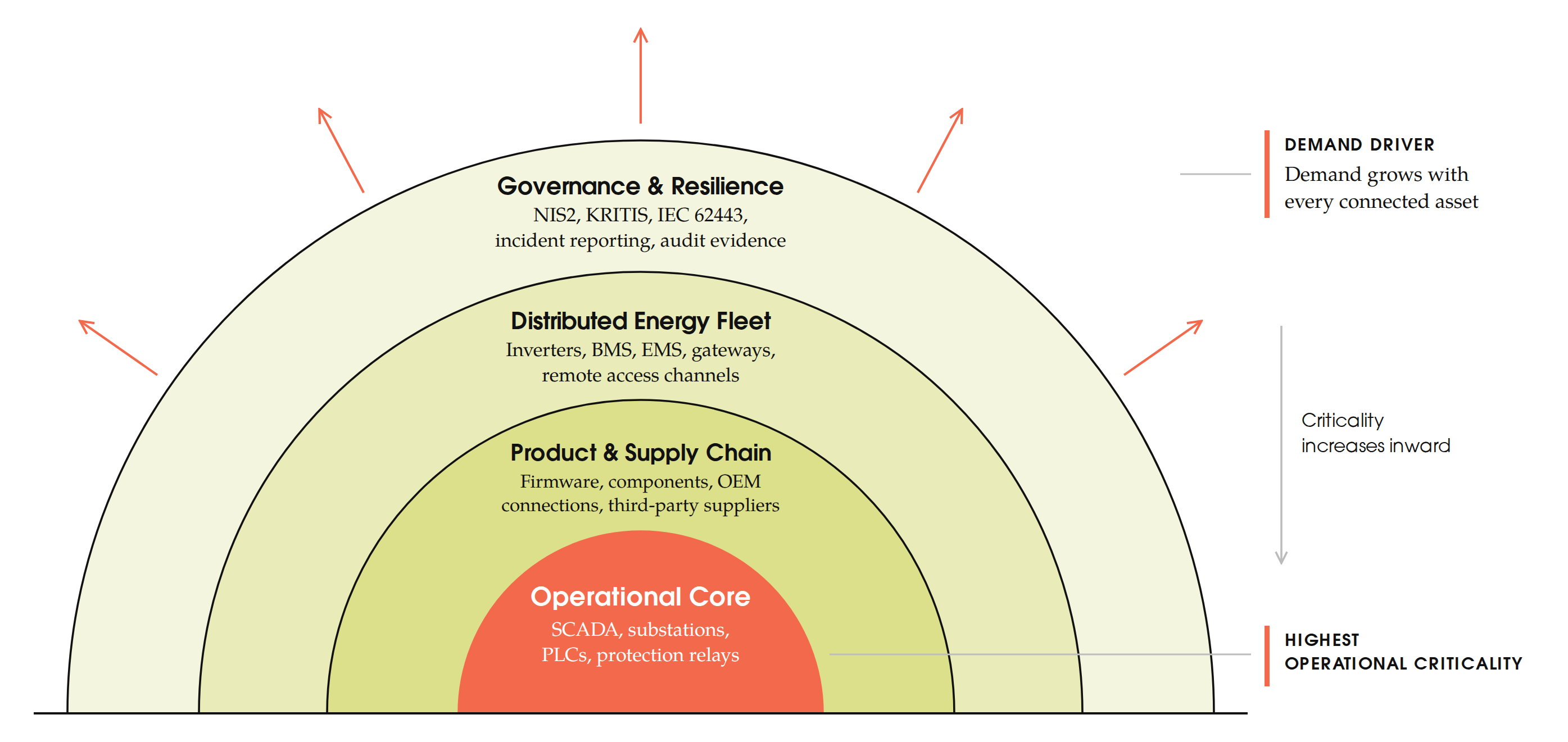
Securing a grid built from connected assets
OT is not IT
Every meter, inverter, battery controller and charger adds digital control to a physical system. The buyer base now includes IPPs, storage and O&M operators and equipment manufacturers, under NIS2, the Cyber Resilience Act and KRITIS.
Distributed fleet security posture management is one of the strongest wedges. The moat is energy-specific device intelligence and auditable workflows, with human approval for high-risk OT actions.
Selling into the grid
what we learned from those who did
Grid operators are regulated monopolies with guaranteed returns on capex. The playbook from our reference calls: enter through a non-critical workflow, price as capex where possible, start with mid-sized DSOs, design pilots to convert, and catch the annual budget cycle.
Once in, you stay in. Prioritize getting embedded over the size of the first contract, then standardize to scale through Germany's fragmented DSO landscape and on to Austria.

Real levers, better solved outside venture capital
Read the full thesis
six parts, glossary, sources
Framework, segment verdicts, market maps, a GTM playbook for selling to grid operators, and full public sources in footnotes.
Download PDFBuilding in one of these spaces?
If you are building in industrial or commercial demand response, thermal flexibility, fleet V2G, the aggregation layer, DSO-facing intelligence or mid-market OT security, we would like to meet you early.
And if you are putting together a conference, a panel or an internal session on the grid, we are glad to come by and walk your audience through the findings.

Former Head of Operations & Finance at Swiss ClimateTech startup FenX, now leading investments at HTGF with a portfolio of 7 companies across Climate Tech and Industrial Software.

Focused on the intersection of energy and industrial AI, including the data center layer and the power and grid infrastructure behind AI workloads.

Operator-turned-investor with 17 years in the European energy industry and 11 years in venture capital.

Former Managing Director of a €250M corporate energy fund with around 50 portfolio companies, and more than €7bn in M&A and investment banking transactions before moving into venture capital.
Vireo Ventures is a Berlin-based venture capital firm backing early-stage founders who build Europe’s future energy tech stack. Vireo invests at pre-seed and seed across Europe in electrification, AI for energy and physical infrastructure.
HTGF is one of Europe’s most active VC investors, backing startups across key technology sectors, including Deep Tech, Industrial Tech and Climate Tech. As a multi-stage VC platform, HTGF supports founders from seed through growth, with follow-on and growth financing available through the DeepTech & Climate Fonds (DTCF) and the HTGF Opportunity Fund. Founders can also submit a pitch deck to HTGF.
Questions about grid venture investing
Short answers drawn from the thesis. The PDF has the full reasoning and sources.
What is The European Grid Deep Dive?
A joint investment thesis by Vireo and High-Tech Gründerfonds (HTGF), published in October 2026. It maps where Europe's grid bottleneck creates opportunities for venture-scale companies, and where incumbents, infrastructure capital or politics are better placed to solve the problem.
Where are the strongest startup opportunities in the European grid?
Industrial and commercial demand response, control software for thermal flexibility, depot fleet charging, the aggregation infrastructure behind virtual power plants, DSO-facing grid intelligence (transparency, forecasting and execution), and security posture management for distributed energy fleets.
Why should grid software startups target DSOs rather than TSOs?
Germany has four transmission system operators with strong in-house build capability and about 870 distribution system operators with limited visibility below the substation. DSOs are more fragmented, less digitized and more exposed to new load from heat pumps, batteries and EVs, which makes them the more open entry point.
Are smart meters a venture opportunity?
Not the meter itself. Smart meters covered 5.9% of German metering points at 30 June 2026. Metering hardware is regulated and margin-thin. The opportunity is the application layer the rollout unlocks, with a revenue path that already works at today's penetration.
How long does it take to sell to a grid operator?
Plan for 6 to 36 months from first meeting to signed pilot, depending on operator size. Utilities budget annually, typically in Q3 or Q4, so a deal that misses the budget window can slip by a full year. Industrial sites, fleets and IPPs usually move faster.
Can the authors speak at our event?
Yes. The authors are happy to present the thesis at conferences, founder and investor events, or internal sessions at utilities and corporates, as a keynote, a panel contribution or a workshop. Get in touch with either contact on this page and share the date, format and audience.
How we researched this
More than 25 structured reference calls with operators and investors including Amprion, Axpo, Encevo, THÜGA, Rhebo, Envelio, EcoPhi, Inframind, EDP Ventures, FEV Ventures and Move Energy, plus TSO, DSO and battery-market participants who prefer not to be named.
Time-sensitive legal and regulatory claims are classified as enacted, adopted but not yet applicable, proposed, announced, or the authors' judgment. Interview findings are labelled as such.
Two exceptions apply: BNetzA's MiSpeL determination of 1 October 2026 and its smart-meter rollout survey of 21 September 2026 are included despite falling after the data cutoff, because they materially change the rules for storage and bidirectional charging (Part IV) and the metering baseline (Part II).
Authors: Vireo and High-Tech Gründerfonds (HTGF) · · Data cutoff
- TSO / DSO
- Transmission / distribution system operator. Germany has 4 TSOs and ~870 DSOs.
- DR
- Demand response: shifting consumption in reaction to price or grid signals.
- VPP
- Virtual power plant: many small assets operated as one tradable unit.
- V1G / V2G
- One-way smart charging / vehicle-to-grid discharge.
- §14a EnWG
- German rule for grid-serving control of heat pumps and wallboxes in exchange for reduced fees.
- NIS2 / CRA
- EU cybersecurity rules for operators (NIS2) and connected products (Cyber Resilience Act).